






Gym Flooring Installation UK | Step-by-Step DIY Guide 2026
Gym Flooring Installation UK: Complete Step-by-Step DIY Guide
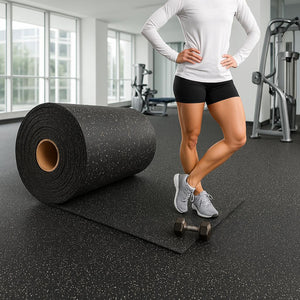
Installing gym flooring yourself is a straightforward, rewarding project that most UK home gym owners complete in a single afternoon. This comprehensive installation guide covers everything from sub-floor preparation to the final finishing touches — including detailed step-by-step instructions for rubber interlocking tiles (the most popular UK gym flooring choice) and tips for professional results.
What You Need Before You Start
Tools and materials required: a tape measure for measuring the room dimensions, a chalk line or pencil for marking cut lines, a sharp utility knife with replacement blades (for 15mm–20mm tiles) or a jigsaw with a coarse blade (for 25mm–30mm tiles), a rubber mallet for seating thick tile connections, a straight edge or metal ruler for guided cuts, and optionally, a knee pad for comfort during tile-laying. No specialist tools or adhesives are required for a standard interlocking tile installation.
Step 1 — Prepare the Sub-Floor
The quality of your installation depends heavily on proper sub-floor preparation. Begin by completely clearing the room of all furniture and equipment. Sweep or vacuum thoroughly to remove all dust, grit, and debris — even small stones can create lumps under rubber tiles that cause uneven surfaces and may damage the tile underside over time. Check the floor for cracks, chips, or high spots. Fill small cracks with a floor repair mortar and allow to cure completely before tiling. For wooden floors, ensure all boards are secure and re-nail any that squeak or move. The floor must be dry — rubber tiles on a damp or wet sub-floor can trap moisture and develop mould underneath.
Step 2 — Plan Your Layout
Good layout planning prevents awkward small tile cuts at the room perimeter and maximises the aesthetic result. Measure the room width and divide by the tile width (1m for standard tiles). If this gives you a remainder of less than 300mm at one or both walls, shift your starting position by half a tile to create wider border tiles on both sides. For most rectangular rooms, starting from the centre or from one full corner is the best approach. Mark your starting position with chalk lines before laying the first tile.
Step 3 — Lay the First Row
Place the first tile at your marked starting position. For interlocking tiles, ensure the puzzle tabs are pointing in a consistent direction — typically the tabs on two adjacent sides connect to the corresponding slots on the next tiles. Press the tiles together firmly. For 20mm+ tiles, use a rubber mallet to fully seat the interlocking edges — a half-seated connection can cause tiles to separate during use. Work across the room, completing full rows before moving to the next row. Keep tiles tight against adjacent tiles — gaps between tiles indicate under-seated connections.
Step 4 — Cut Edge Tiles
At room edges, measure the gap between the last full tile and the wall. Mark this measurement on a fresh tile and score the cut line 5–6 times with a utility knife using a metal straight edge. For tiles up to 20mm thick, score deeply on both the top surface and edge, then bend and snap cleanly along the score line. For 25mm–30mm tiles, score both sides and use a jigsaw with a coarse-tooth blade to cut cleanly. Always cut tiles slightly shorter than the exact measurement — a 3–5mm gap at the wall allows for thermal expansion and makes edge tiles easier to fit.
Step 5 — Cut Around Obstacles
For columns, drains, and other obstacles, create a cardboard template by cutting and fitting it around the obstacle before transferring the shape to the rubber tile. Complex cuts (L-shapes, curves) are best made with a jigsaw. For round obstacles, use a compass or circular template to mark the cut. Always cut slightly oversize first and trim incrementally — rubber cannot be uncut.
Step 6 — Install Edge Ramp Strips
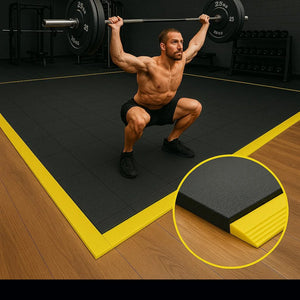
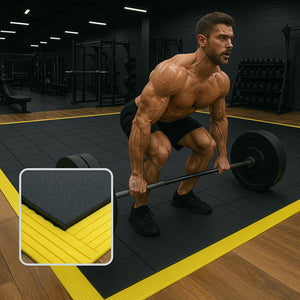
Ramp edge strips create a professional, trip-free transition between your rubber floor and the surrounding flooring. They're particularly important at doorways and at the edges of partially-covered floors. Ramp strips typically interlock with the tile edge or sit butted against it. They can be held in place with double-sided tape or flooring adhesive for a permanent finish. Install corner pieces where two ramp strips meet at room corners for a neat, professional finish.
Step 7 — Final Check
Walk over the entire floor, pressing firmly on all tile joints. Any tiles that flex or rock indicate a sub-floor irregularity or poorly-seated interlocking joint — lift and re-seat these tiles. Check all cut edges lie flat against the wall with no lifted corners. Once satisfied, your gym floor is ready to use immediately — no curing time is required for rubber interlocking tiles.
Common Installation Mistakes to Avoid
Laying tiles on a dirty or uneven sub-floor is the most common mistake — always clean and prepare thoroughly. Starting from a wall rather than planning the layout first often results in very small cut tiles at the opposite wall. Not using a mallet on thick tiles leaves connections under-seated. Cutting tiles to the exact wall measurement without a small expansion gap can cause tiles to buckle if the room gets warm. Forgetting to order ramp edge strips means awkward exposed tile edges — always order these at the same time as your tiles.
How Long Does Gym Flooring Installation Take?
A typical home gym floor of 15–25 square metres takes one person approximately 3–5 hours from start to finish, including sub-floor preparation and edge finishing. Larger commercial installations of 100+ square metres are typically completed by a 2-person team in one working day. GymFlooringUK's professional installation service is available for commercial projects — contact our team for a quotation.
Gym flooring installation UK guide covering floor mats, flooring options for commercial facilities. Keep rubber over time clean dry and level with swept floors to avoid harsh chemicals. Prevent dropped weights damage.
